
What the doctor visit doesn't tell you
A 15-minute appointment captures a snapshot. Your parent's daily living is a movie. The gap between what the doctor sees and what the family sees is where the real information lives.
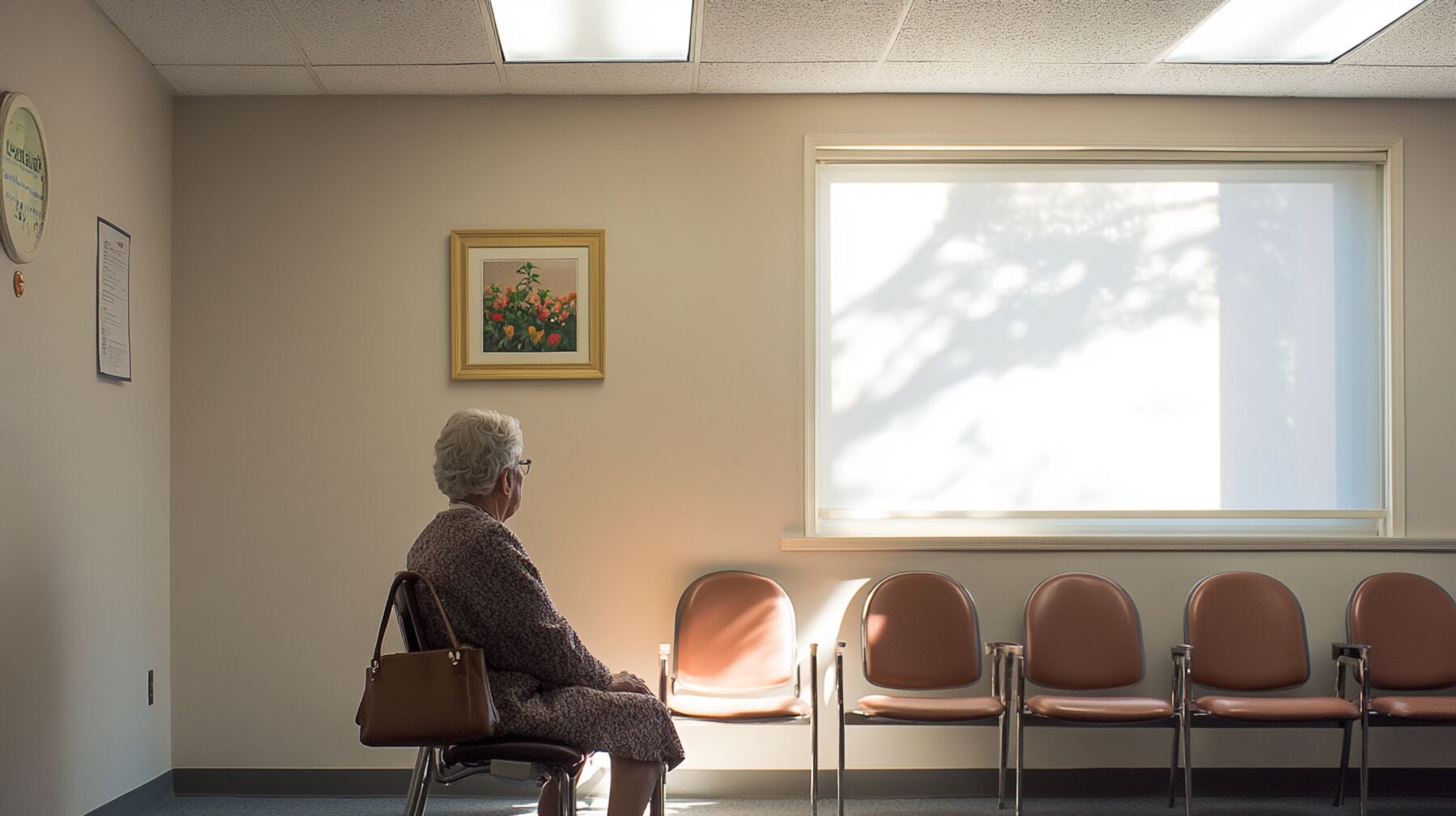
The doctor says she's doing well. Her vitals are stable. Her labs look good. Her weight is within range. She answered the cognitive screening questions correctly. The appointment took 14 minutes.
You drive home together. She can't find her keys in her purse. She forgets where you parked. In the car, she asks you the same question three times: did you talk to your sister about Thanksgiving? She asked you on the way to the appointment too.
The doctor saw Tuesday at 2pm. You see every day.
What a clinical visit actually measures
A standard geriatric appointment covers vitals (blood pressure, heart rate, weight), lab work (if ordered), a medication review, and a brief cognitive or functional screen. The visit lasts 12 to 20 minutes. In that window, the physician is assessing against clinical thresholds: Is anything acutely wrong? Do the numbers fall outside normal ranges? Is there a diagnosable condition present?
This is valuable. It catches hypertension, infection, thyroid dysfunction, medication interactions. It identifies treatable conditions that explain functional changes. No one should skip doctor's appointments.
But the clinical model has structural limitations that families need to understand, not to dismiss medicine, but to know what it can and cannot see.
Clinical visits measure capability in a controlled moment. Can she recall three words after five minutes? Can she draw a clock? Can she name the current president? These are threshold tests designed to flag significant impairment. They don't capture subtle, gradual shifts in daily function.
Clinical visits happen at intervals. Every three months, every six months. Between visits, daily living continues without clinical observation. A lot can change in 90 days that a 15-minute check won't capture unless the patient or family specifically reports it.
Clinical visits see the patient, not the context. The doctor doesn't see the kitchen, the fridge, the mail, the sleep pattern, the social withdrawal, the unopened books, the unworn shoes by the door. Daily living happens inside a life, not inside an exam room.
The performance effect
Your parent rallies for the doctor. This is not deception. It's human nature, amplified by generational respect for medical authority and the simple social energy of being in a structured interaction with another person.
The performance effect is well-documented in geriatric medicine. Patients present at their best during appointments: more alert, more articulate, more oriented than their daily baseline. The white coat, the focused attention, the brief duration of the interaction all contribute to a version of the person that is real but not representative.
Families see the performance and feel gaslit. The doctor says she's fine. You know she's not fine. But "not fine" is hard to articulate when the person in question just passed a Mini-Mental State Exam.
The performance effect is why clinical assessments and family observations are complementary, not competing. The doctor's "she's fine" means: in this moment, using these instruments, I don't see clinical impairment that crosses a diagnostic threshold. Your "she's not fine" means: over the last three months, her daily living pattern has shifted in ways I can see but can't quantify.
Both are true. Neither is the whole picture.
What clinical visits don't capture
Mood trends. Not "does she seem depressed right now" but "has she been withdrawing for six weeks." Depression screening instruments are point-in-time. They don't capture trajectory.
Social withdrawal. The doctor doesn't know she stopped calling her friend. Doesn't know she declined the book club invitation. Doesn't know the phone rings less because she stopped being the one who initiates.
Engagement decline. The crossword that sits untouched. The garden that's going to weeds. The television on all day when she used to read. These are gradual shifts in engagement with life that happen between appointments.
Sleep disruption patterns. Not "did you sleep well last night" but "you've been sleeping 13 hours a day for three weeks and you used to wake at 6am to walk."
Subtle mobility changes. The hand on the wall. The avoidance of stairs. The slower gait that hasn't crossed into fall risk on a clinical assessment but represents a meaningful change from her baseline six months ago.
Hygiene shifts. Decreased bathing frequency, unwashed clothes, a home that used to be immaculate and now has visible disorder. These are sensitive dimensions that patients rarely self-report and clinicians rarely ask about directly.
Nutrition changes. The duplicate groceries, the weight loss that happens between weigh-ins, the shift from cooking to frozen meals to not eating regularly. Unless it shows up on the scale during an appointment, it's invisible to the clinical eye.
The gap between
There's a gap between what clinical medicine measures and what daily living reveals. It's not a criticism of medicine. It's a structural reality. Clinicians are trained to identify pathology. Families observe function. Pathology is what's wrong. Function is how life is actually going.
A person can have no diagnosable pathology and still be declining functionally. Their cognition hasn't crossed a clinical threshold, but their engagement with life has narrowed. Their mobility isn't impaired by medical definition, but they've stopped leaving the house. Their mood hasn't met criteria for major depressive disorder, but they've become a different person.
This is the monitoring-to-meaning gap. Families are monitoring (watching, noticing, worrying). But without a framework, that monitoring doesn't convert into meaning. It stays as ambient anxiety, occasionally validated by a crisis and routinely dismissed by a doctor's reassurance.
What families need alongside clinical care
Families don't need to replace the doctor visit. They need their own observational framework that captures what happens between visits. Something that accounts for the dimensions of daily living that clinical instruments don't address: engagement, social contact, mood trajectory, hygiene, nutrition patterns, autonomy.
This isn't about families playing doctor. It's about families being systematic observers of the thing they're already observing. Naming the dimension. Tracking it over time. Sharing what they see with each other so that one person's Tuesday and another person's Saturday become part of the same picture.
The doctor sees the vitals. You see the life. Both matter. But right now, only one of those observations has a system for capturing it.
This is part of Kintently's family caregiving library.