
The caregiver burnout guide: signs, causes, and what helps
Caregiver burnout builds quietly. Learn the signs family caregivers miss, why it accumulates, and what actually shifts the load.
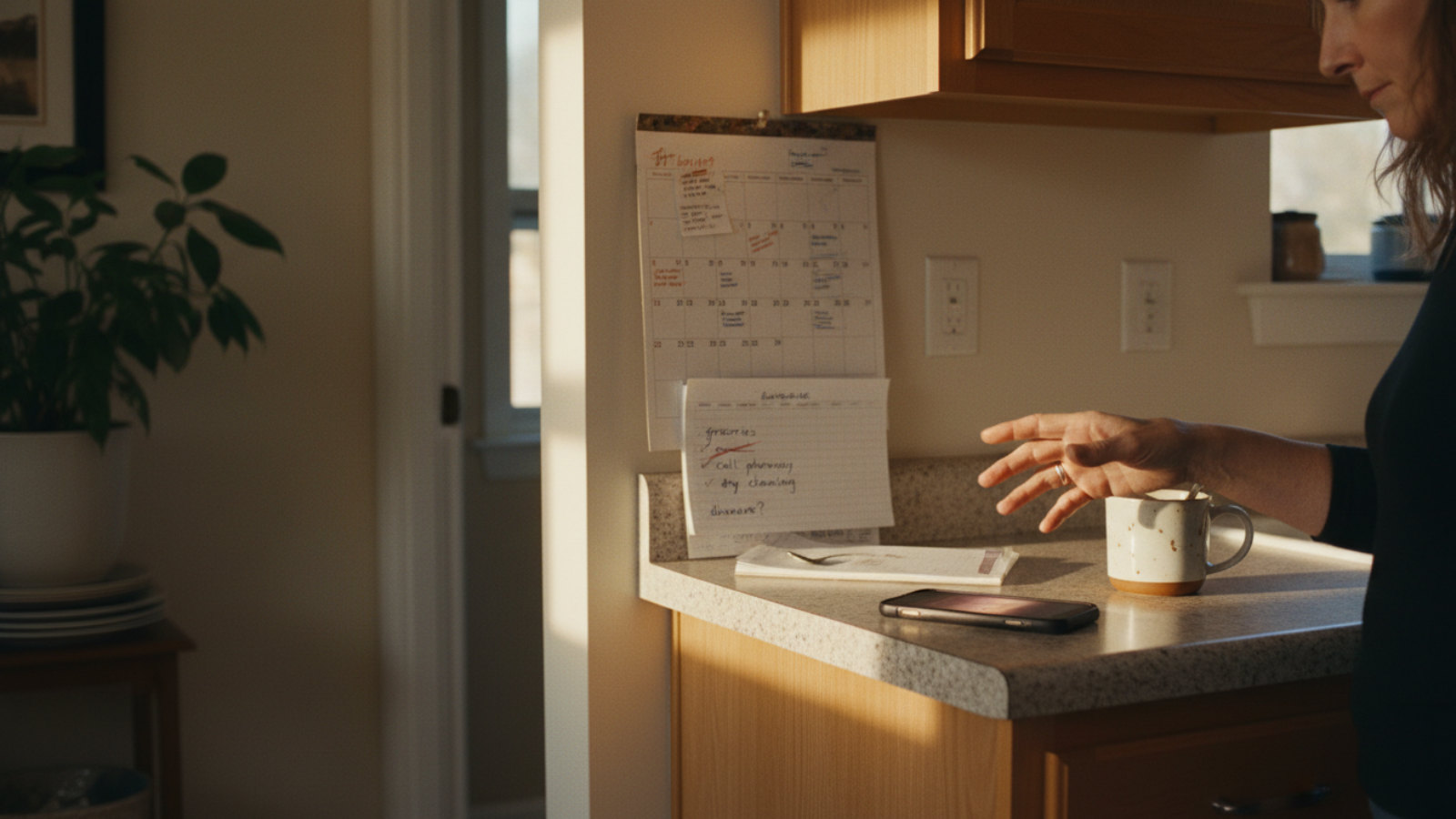
You started by helping with groceries. Then it was the doctor's appointments. Then it was the medication schedule, the insurance calls, and the 11 p.m. texts from your brother asking how Mom seemed today.
Nobody sat you down and said, "You're a caregiver now." It just became true. And somewhere between managing her daily needs and managing your own life, you stopped being able to tell whether you were tired or something worse.
Caregiver burnout is that something worse, the accumulation of weeks, months, sometimes years of sustained responsibility without enough rest, enough help, or enough information about whether what you're doing is actually working.
This guide shares general information for family caregivers and doesn't replace advice from your doctor. The InPlace Score and the burnout quiz record observations and aren't clinical assessments. If you're having thoughts of harming yourself, call or text 988 to reach the Suicide and Crisis Lifeline. For chest pain, trouble breathing, or another emergency, call 911.
What caregiver burnout actually is
Caregiver burnout is a state of physical, emotional, and cognitive exhaustion caused by prolonged caregiving without adequate support or recovery. It differs from ordinary stress or fatigue in that a weekend off rarely resolves it, because the conditions that created it are still there when you come back.
According to AARP's 2025 Caregiving in the US report, 63 million Americans are now providing care for a family member. That's nearly one in four adults. Nearly one in four caregivers provide 40 or more hours of care a week, one in five report fair or poor health, and nearly one in four say they struggle to take care of their own health because of caregiving.
If you're reading this, some of those numbers probably describe you.
The signs that don't make the symptom lists
Most lists of burnout symptoms read like a medical textbook: fatigue, irritability, sleep disruption, weakened immune function. Those are real. But they're also generic enough to describe anyone who's had a hard month.
The signs that show up in family caregivers in particular are more specific:
You've stopped noticing changes in your parent. You used to catch small shifts in how Mom moved through the kitchen, whether she remembered to eat lunch, how she sounded on the phone. Now the days blur together. You can't tell if last Tuesday was different from this one. That loss of observational sharpness can be a burnout signal.
You dread the phone ringing. Every call might add one more thing to manage, so the phone becomes a vector for obligation, and your body responds before your brain does.
You resent the people who aren't helping. Your brother calls once a week and asks, "How's Mom doing?" and the question makes you angry. It's a fair question, and he gets to just ask it, while you have to know the answer.
You've lost the ability to rest when rest is available. Saturday afternoon, nothing urgent, and you're staring at the ceiling running mental inventories. Did she take her medication? Is the bathroom grab bar secure? When was her last blood pressure reading? Your body is still, but your nervous system isn't.
You minimize when people ask how you're doing. "I'm fine." "It's not that bad." "Other people have it worse." It's a coping mechanism that protects you from the full weight of what you're carrying, and it makes it harder for anyone to help.
If several of these sound familiar, treat them as a pattern worth taking seriously.
Why burnout builds the way it does
Caregiver burnout accumulates, and the way it builds is easy to miss until you're deep in it.
The information gap. You're watching your parent every day, noticing small things, and you have no way to tell whether what you're seeing is normal aging or something that needs attention. That uncertainty is cognitively expensive. Your brain spends energy trying to pattern-match observations against outcomes, and it never gets a clear answer. Over time, that ambiguity can wear you down as much as the tasks themselves.
The coordination tax. If you have siblings or other family members involved, you're spending a significant amount of energy translating what you see into updates they can understand. It happens in the group chat, on Sunday phone calls, and in "she seemed off today" texts that nobody knows how to respond to. Coordination without shared visibility adds to the cognitive load, and you become the family's single source of truth, so you can never fully step away.
The identity compression. Before you were a caregiver, you were a lot of things. You had a career, friendships, hobbies, a sense of yourself as a separate person. Caregiving compresses that identity over time. When someone asks what's new, the only honest answer is about your parent. Your own life gets smaller, and you stop noticing because it happens gradually.
The absence of a score. Most of life's hard work comes with some form of feedback. Work has performance reviews. Fitness has the scale or the mile time. Caregiving has nothing. You don't know if you're doing well. You don't know if things are getting worse slowly or holding steady. That absence of a measuring stick means you can't calibrate your effort, and many caregivers default to doing more. That speeds up the burnout.
The difference between burnout and compassion fatigue
People use these terms interchangeably, but they're different, and the difference matters for how you respond.
Caregiver burnout comes from the sustained weight of the role itself: the logistics, the coordination, the decision-making, the lack of rest. It's structural. You could love what you're doing and still burn out because the workload exceeds your capacity.
Compassion fatigue comes from the emotional exposure to someone else's suffering. Watching your parent struggle, lose capabilities, or experience pain takes a toll on your own emotional reserves. It's empathic. You absorb the difficulty of their experience alongside your own.
Many family caregivers experience both at once, so they're hard to untangle. But the interventions are different. Burnout responds to structural changes: more help, better information, shared responsibility. Compassion fatigue responds to emotional recovery: time away, connection with people outside the caregiving context, permission to feel something other than worry.
If you're not sure which one you're dealing with, the Kintently burnout quiz can help you get a clearer read on where you stand.
What actually helps (and what doesn't)
There's no shortage of advice for burned-out caregivers. Most of it sounds like this: "Remember to take care of yourself." "You can't pour from an empty cup." "Schedule time for self-care."
That advice is incomplete. Telling a caregiver to take care of themselves without addressing the structural conditions that created the burnout is like telling someone in a leaking boat to stay dry.
Shared visibility reduces cognitive load
One of the most useful things you can do is give the rest of your family a shared, structured view of how your parent is actually doing, one they can check without waiting for your next text or Sunday phone call.
When your brother can see that Mom's mobility score has dipped from Good to Steady over the past three weeks, you don't have to explain it. You don't have to translate your observations. You don't have to be the sole interpreter of reality. That shift from "I think something's off" to "the score shows a shift" changes the family conversation.
Kintently's InPlace Score tracks 15 dimensions of daily living, from bathing, dressing, mobility, and eating to medications, transportation, finances, and shopping. Each dimension gets a score, and the composite falls into one of five status bands: Strong, Good, Steady, Watch, or Concern. The whole family sees the same score, and for many caregivers that shared view is the first structural change worth making.
Ask for specific help
"Let me know if you need anything" is the most common and least useful offer in caregiving. The person making it means well. But the cognitive cost of figuring out what to ask for, and then asking, is often higher than just doing the thing yourself.
Instead, create a list of specific tasks that others can take on without you having to manage them, such as grocery delivery, pharmacy pickup, or a Tuesday afternoon visit so you can leave the house for three hours. The more specific the ask, the more likely it gets done, and the less energy you spend coordinating it.
Track the trends
One bad day doesn't mean decline. One good day doesn't mean recovery. Reacting to every individual data point can make burnout worse, and the pattern over time is a calmer guide.
When you can look at two weeks of check-ins and see that your parent's scores have been steady, your nervous system can stand down a little. When you can see that a dip in mobility lasted three days and then recovered, you can make a better decision about whether to call the doctor.
A trend line is easier to live with than a string of isolated observations, each of which can feel like an alarm.
The check-in includes you
Kintently's check-in also tracks the person doing the caring. A primary caregiver running on empty affects the whole care arrangement, whatever the parent's status, so your own capacity is part of what the check-in records.
Professional help has a threshold
If you're experiencing sustained sleep disruption, intrusive worry about your parent's health, chronic headaches, or a persistent inability to feel joy even in moments that should bring it, structural changes alone may not be enough. Talk to your doctor or a therapist who understands caregiving. Chest pain or other sudden physical symptoms need medical attention right away, so call 911 if they're severe. If you're having thoughts of harming yourself, call or text 988 to reach the Suicide and Crisis Lifeline. Asking for that help is a reasonable response to carrying more than one person should carry.
How to check in with yourself
Start with your own energy, separate from your parent's health. On a scale of one to 10, how would you rate it over the past week? If the number is consistently below five, pay attention to it.
Then ask: when was the last time you did something for yourself that had nothing to do with caregiving? If you can't remember, that's also information.
Kintently's burnout quiz takes a few minutes and gives you a read on where you stand. It's an observational signal with no diagnostic weight, a way to see your own patterns the way you've been trying to see your parent's.
What to do this week
One or two changes that shift the load will do more this week than a life overhaul.
If you're the only one watching: Invite one family member into a shared view of your parent's status, even if they're across the country. Start a family check-in and let the score do the explaining.
If you're managing everything by text: Replace the next group chat update with a score. "Mom's Steady overall, Watch in mobility" carries more information and less emotional labor than a five-paragraph text.
If you can't remember the last time you rested: Block two hours this week for something unrelated to care, productive or not. Your capacity isn't infinite, and pretending it is accelerates the burnout.
If reading this guide felt like reading about yourself: Take the burnout quiz. It shows you where you stand, and deciding what to do about it starts there.
Frequently asked questions
What is caregiver burnout? Caregiver burnout is a state of physical, emotional, and cognitive exhaustion caused by prolonged caregiving without adequate rest or support. It tends to persist after a day off, because the conditions that caused it are still there. In AARP's 2025 Caregiving in the US report, one in five family caregivers reported fair or poor health.
What are the early signs of caregiver burnout? Early signs include difficulty noticing changes in your parent's daily patterns, dreading phone calls, resentment toward family members who aren't helping, inability to rest when rest is available, and minimizing your own needs when asked how you're doing. These patterns often appear before the more commonly cited symptoms like chronic fatigue and irritability.
How is caregiver burnout different from compassion fatigue? Burnout comes from the structural weight of the caregiving role itself: logistics, coordination, decision-making, and lack of rest. Compassion fatigue comes from emotional exposure to another person's suffering. Many family caregivers experience both at once. Burnout responds to structural changes like shared responsibility and better information. Compassion fatigue responds to emotional recovery like time away and connection outside the caregiving context.
How can I measure or track caregiver burnout? Kintently's InPlace Score tracks 15 dimensions of daily living, and the check-in also tracks the burnout level of the person doing the caring. Together they give you and your family a shared, structured view of how your parent is doing and how you're holding up. You can also take Kintently's burnout quiz for a quick read on where you stand.
Suggested JSON-LD (Article schema):
{
  "@context": "https://schema.org",
  "@type": "Article",
  "headline": "The caregiver burnout guide: signs, causes, and what helps",
  "description": "Caregiver burnout builds quietly. Learn the signs family caregivers miss, why it accumulates, and what actually shifts the load.",
  "author": {
    "@type": "Organization",
    "name": "Kintently"
  },
  "publisher": {
    "@type": "Organization",
    "name": "Kintently",
    "logo": {
      "@type": "ImageObject",
      "url": "https://kintently.com/logo.svg"
    }
  },
  "datePublished": "2026-06-03",
  "dateModified": "2026-06-03",
  "mainEntityOfPage": "https://kintently.com/resources/caregiver-burnout-guide",
  "keywords": ["caregiver burnout", "caregiver burnout symptoms", "signs of caregiver burnout", "caregiver burnout recovery", "caregiver burnout quiz"]
}
{
  "@context": "https://schema.org",
  "@type": "FAQPage",
  "mainEntity": [
    {
      "@type": "Question",
      "name": "What is caregiver burnout?",
      "acceptedAnswer": {
        "@type": "Answer",
        "text": "Caregiver burnout is a state of physical, emotional, and cognitive exhaustion caused by prolonged caregiving without adequate rest or support. It tends to persist after a day off, because the conditions that caused it are still there. In AARP's 2025 Caregiving in the US report, one in five family caregivers reported fair or poor health."
      }
    },
    {
      "@type": "Question",
      "name": "What are the early signs of caregiver burnout?",
      "acceptedAnswer": {
        "@type": "Answer",
        "text": "Early signs include difficulty noticing changes in your parent's daily patterns, dreading phone calls, resentment toward family members who aren't helping, inability to rest when rest is available, and minimizing your own needs when asked how you're doing. These patterns often appear before the more commonly cited symptoms like chronic fatigue and irritability."
      }
    },
    {
      "@type": "Question",
      "name": "How is caregiver burnout different from compassion fatigue?",
      "acceptedAnswer": {
        "@type": "Answer",
        "text": "Burnout comes from the structural weight of the caregiving role itself: logistics, coordination, decision-making, and lack of rest. Compassion fatigue comes from emotional exposure to another person's suffering. Many family caregivers experience both at once. Burnout responds to structural changes like shared responsibility and better information. Compassion fatigue responds to emotional recovery like time away and connection outside the caregiving context."
      }
    },
    {
      "@type": "Question",
      "name": "How can I measure or track caregiver burnout?",
      "acceptedAnswer": {
        "@type": "Answer",
        "text": "Kintently's InPlace Score tracks 15 dimensions of daily living, and the check-in also tracks the burnout level of the person doing the caring. Together they give you and your family a shared, structured view of how your parent is doing and how you're holding up. You can also take Kintently's burnout quiz for a quick read on where you stand."
      }
    }
  ]
}
This is part of Kintently's family caregiving library.