
Family caregiving coordination: how to share the load without the fights
Share caregiving responsibilities with siblings by naming the work, dividing it by capacity, and giving everyone the same picture of how your parent is doing.
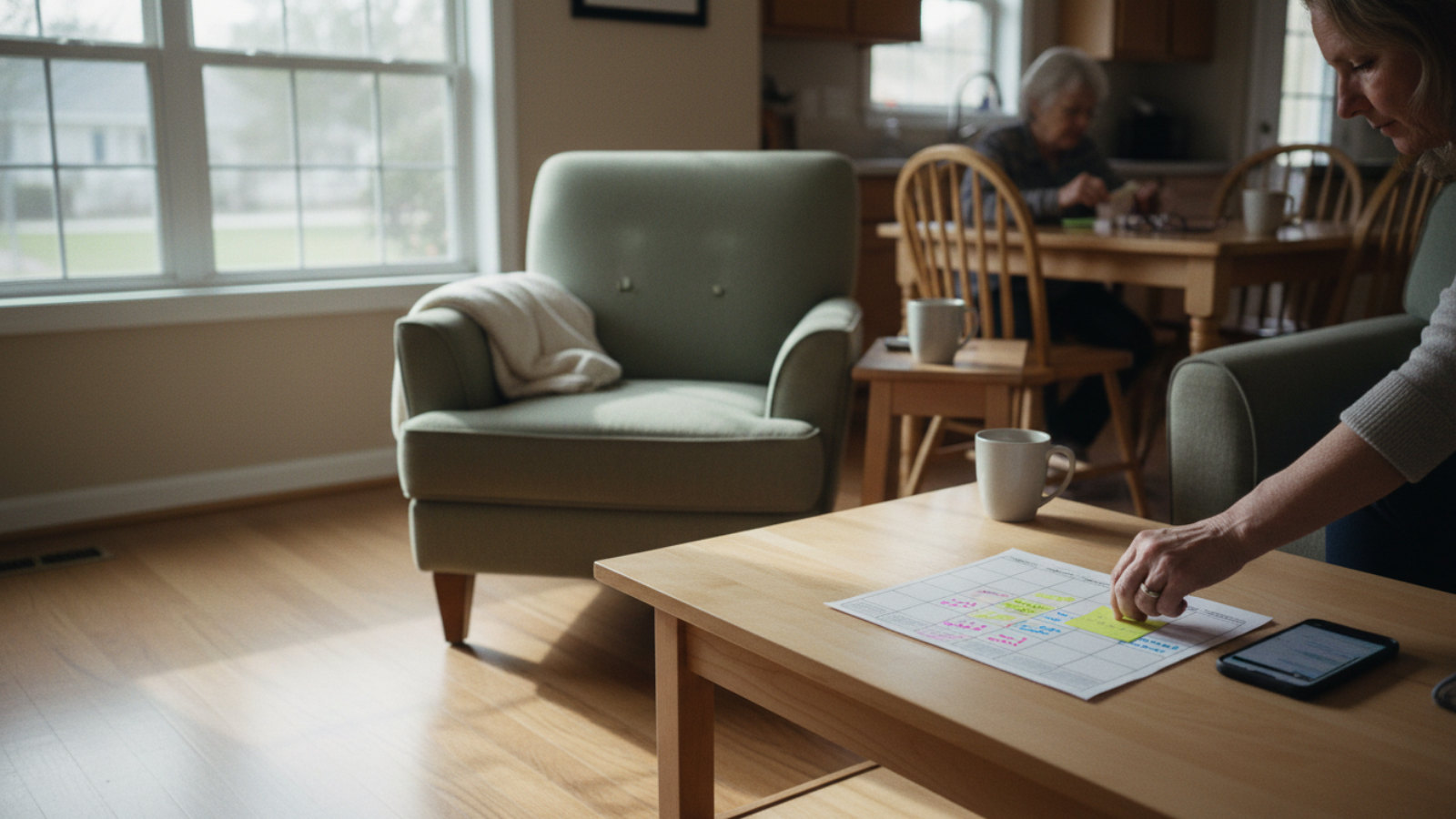
In most families, care for an aging parent lands on someone before anyone decides who. One person, usually the one who lives closest or worries most, starts handling things. The others assume it's covered, because it is. That's how you share caregiving responsibilities in most families: by accident, and unevenly, until the person carrying it runs out of room.
The arguments that follow tend to sound like they're about a missed phone call, a comment at Thanksgiving, or who showed up and who didn't. Underneath, it's often the same thing. One sibling is doing far more than the others know, and the others are working from a version of the situation that stopped being true months ago.
This is more common than it feels when you're in it. AARP and the National Alliance for Caregiving's Caregiving in the U.S. 2025 report counts about 63 million adults who provided ongoing care in the past year, close to one in four U.S. adults. Many of those families are coordinating across siblings, distance, and old roles that don't fit the new situation. The way through is to divide the work on purpose, so the load is shared and the family is still speaking when it's over.
This article is general information for families. The InPlace Score is not a medical assessment. If you have concerns about your parent's health, consult their healthcare provider.
Why the load lands on one person
Caregiving concentrates on one person because the work is invisible until you're the one doing it. From the outside, "checking on Mom" sounds like a phone call. From the inside, it's the call, the pharmacy run, the appointment you booked and drove to, the bills you noticed were unpaid, the night you didn't sleep because she sounded off and you couldn't tell if it mattered.
The hours bear this out. The same report found nearly one in four caregivers provides 40 or more hours of care a week, the hours of a full-time job, and six in 10 caregivers also hold a paid job. When that much work concentrates on a single person, the rest of the family rarely registers the size of it.
Proximity decides by default. Whoever lives closest becomes the responder, and responding turns into owning. Once you're the one who shows up for the emergency, you're the one who shows up for everything.
Old family roles harden. The sibling who was always "the responsible one" gets handed the responsible-one job again, decades later, without anyone voting on it. The one who was "bad with this kind of thing" stays exempt.
And the work hides itself. The primary caregiver absorbs each new task quietly, because handling it is faster than explaining it. Every time you do that, the gap between what you carry and what your siblings think you carry gets a little wider. By the time you ask for help, you're asking people who genuinely don't see the problem, because you've been the reason they can't see it.
Nobody has to act in bad faith for this to happen, because the default does it on its own. Sharing the load takes a deliberate decision to make the work visible and divide it on purpose.
The real reason siblings fight about care
Siblings fight about caregiving because they're looking at different versions of the same parent. The brother who visits twice a year sees a parent who showered, dressed, and rallied for the weekend. The daughter who lives 10 minutes away sees the version that can't follow a recipe she's made for 40 years. Both are telling the truth. Neither is describing the same picture.
That gap is where conflict lives. When the far-away sibling says "Mom seems fine to me," the nearby one hears "you're exaggerating," and the resentment that's been building for months finally has somewhere to go. We wrote about this directly in what if everyone could see the same thing. What's missing is shared information.
The usual fix makes it worse. Families lean on the group chat, and a group chat is built for moments. "Mom seemed confused today." Someone replies "she was fine yesterday." Nothing gets tracked, nothing gets resolved, and the person typing the most is the person already doing the most. We pulled that apart in the group chat isn't working. A feed of updates never adds up to a shared read on how your parent is actually doing.
So the argument repeats with a new trigger each time. Until everyone is looking at one version of the truth, you're disagreeing about what's real, and that fight has no end.
How to share caregiving responsibilities on purpose
Sharing the load starts with naming the work, because you can't divide a job nobody can see. Before you assign anything, write down every task one person is currently doing: medications, the pharmacy, doctor's appointments and the driving, bills and insurance, groceries and meals, the daily or weekly check-in, home repairs, and the emotional labor of being the one who worries. The list is usually longer than anyone expected, including the person who's been carrying it.
Then divide by capacity. Aim for a workable split that matches what each person can actually do, even if it isn't equal.
- Local, hands-on tasks go to whoever is nearby: in-person check-ins, driving to appointments, responding to the unexpected.
- Remote, administrative tasks travel well and don't need proximity: bills, insurance, scheduling, ordering supplies, researching options, managing the calendar. A sibling three states away can own all of it.
- Money is its own lane. A sibling who can't give time can fund a house cleaner, a meal service, or a few hours of respite care, and that counts as a real contribution.
- The check-in should rotate so the same person isn't always the bearer of bad news, and so more than one set of eyes is on your parent over time.
Put it in writing and revisit it. A parent's needs change, and a split that worked in spring may not hold in fall. A standing monthly conversation to adjust the plan beats a blowup when one person hits their limit. Distance still leaves plenty to own. As we covered in when the sibling who lives far away wants to help, the far sibling usually lacks a way to see what's happening and a job that fits the distance. Give them both.
Give everyone the same picture
A fair division of labor falls apart without shared visibility, because the moment one person can't see the situation, they drift back to assuming it's handled. Families often skip this step, and it holds the rest of the plan together.
Shared visibility means everyone works from the same dated record of how your parent is doing over time. When the far-away brother can see that mobility has slipped for three weeks running, he doesn't need to be convinced it's serious. He can see it, and the argument about whether it's real has much less to stand on.
Kintently's InPlace Score gives a family that record. It tracks 15 dimensions of daily living, including mobility, eating, medications, and socialization, and rolls them into one status the whole family can see. Each parent sits in one of five bands, from Strong down to Concern, so "Dad's at Watch on mobility this month" replaces "I think Dad's getting wobbly." The family check-in also asks how the primary caregiver is holding up, because the person doing the watching is part of the picture. When the load is too heavy on one person, the family can see that too, in the same place they see everything else.
A shared status turns observation into a reference everyone trusts, so decisions get made from what the family has recorded instead of from whoever spoke last or loudest. If you want a structured way to know what to watch for in the first place, our aging parent assessment guide walks through the signs and how to read them.
Protect the person carrying the most
The primary caregiver is often the part of the system nobody monitors. Sharing the load also keeps the one person holding it from quietly burning out while everyone assumes the situation is stable.
Watch for the signs in yourself or in whoever is carrying the most: exhaustion that sleep doesn't fix, resentment that's started leaking into everything, a short fuse, dropping the things that used to keep you steady. They point to a design problem, with one person absorbing what a family should be sharing.
What helps a depleted caregiver is taking three jobs off their list and handing them to someone else, permanently.
If you're the one carrying the most and you're not sure how close to the edge you are, the Kintently burnout quiz takes a few minutes and gives you a reading. If you're the sibling watching someone else carry it, that quiz is also a way to understand what you're actually asking them to keep doing, and why "let me know if you need anything" so rarely produces help.
If the strain has turned into hopelessness or thoughts of harming yourself, call or text 988 to reach the Suicide and Crisis Lifeline, or call 911 if you're in immediate danger.
Caregiving will still be hard when the work is shared, and it will be lighter for the person who never agreed to do it alone. That starts with seeing the same thing, dividing the work on purpose, and checking in often enough to catch the strain before it breaks something. See how a shared family check-in works.
Frequently asked questions
How do you share caregiving responsibilities with siblings? Start by writing down every task one person is currently doing, from medications and appointments to bills and the daily check-in. Then divide by what each person can actually do. Local, hands-on tasks go to whoever is nearby, while remote work like bills, scheduling, and insurance can be owned by a sibling at any distance. A sibling who can't give time can fund respite care or services. Put the plan in writing and revisit it monthly, because a parent's needs change. The piece most families skip is shared visibility: everyone working from the same record of how the parent is doing, so the division of labor doesn't quietly collapse back onto one person.
Why does one sibling always end up doing all the caregiving? Caregiving concentrates on one person because the work is invisible until you're doing it, and the defaults push it onto whoever is closest. Proximity turns responding into owning, old family roles get reassigned without discussion, and the primary caregiver absorbs each new task quietly because handling it is faster than explaining it. Over time that widens the gap between what one person carries and what the others think is happening, until asking for help means asking people who genuinely don't see the problem.
How do we stop fighting about our parent's care? Much sibling conflict about care comes from looking at different versions of the same parent. The far-away sibling sees a parent who rallied for a visit, and the nearby one sees the daily reality. Both are telling the truth. The fight usually eases when everyone works from one shared record of how the parent is doing over time, instead of from their own most recent impression. A shared status that tracks daily living across weeks replaces the argument about what's real with a picture everyone can see.
How can a long-distance sibling actually help? A long-distance sibling can own everything that doesn't require proximity: bills, insurance, scheduling appointments, ordering supplies, researching care options, and managing the calendar. They can also fund services like cleaning, meals, or respite care, which is a real contribution. Shared visibility is what makes remote help work. When a far-away sibling can see how their parent is doing over time, they can act on real information instead of relying on a stressed weekly phone summary from the primary caregiver.
Suggested JSON-LD (Article schema):
{
  "@context": "https://schema.org",
  "@type": "Article",
  "headline": "Family caregiving coordination: how to share the load without the fights",
  "description": "Share caregiving responsibilities with siblings by naming the work, dividing it by capacity, and giving everyone the same picture of how your parent is doing.",
  "author": {
    "@type": "Organization",
    "name": "Kintently"
  },
  "publisher": {
    "@type": "Organization",
    "name": "Kintently",
    "logo": {
      "@type": "ImageObject",
      "url": "https://kintently.com/logo.svg"
    }
  },
  "datePublished": "2026-07-01",
  "dateModified": "2026-07-01",
  "mainEntityOfPage": "https://kintently.com/resources/family-caregiving-coordination-guide",
  "keywords": ["share caregiving responsibilities", "family caregiving coordination", "sibling caregiver communication", "long distance caregiving", "caregiving family conflict"]
}
{
  "@context": "https://schema.org",
  "@type": "FAQPage",
  "mainEntity": [
    {
      "@type": "Question",
      "name": "How do you share caregiving responsibilities with siblings?",
      "acceptedAnswer": {
        "@type": "Answer",
        "text": "Start by writing down every task one person is currently doing, from medications and appointments to bills and the daily check-in. Then divide by what each person can actually do. Local, hands-on tasks go to whoever is nearby, while remote work like bills, scheduling, and insurance can be owned by a sibling at any distance. A sibling who can't give time can fund respite care or services. Put the plan in writing and revisit it monthly, because a parent's needs change. The piece most families skip is shared visibility: everyone working from the same record of how the parent is doing, so the division of labor doesn't quietly collapse back onto one person."
      }
    },
    {
      "@type": "Question",
      "name": "Why does one sibling always end up doing all the caregiving?",
      "acceptedAnswer": {
        "@type": "Answer",
        "text": "Caregiving concentrates on one person because the work is invisible until you're doing it, and the defaults push it onto whoever is closest. Proximity turns responding into owning, old family roles get reassigned without discussion, and the primary caregiver absorbs each new task quietly because handling it is faster than explaining it. Over time that widens the gap between what one person carries and what the others think is happening, until asking for help means asking people who genuinely don't see the problem."
      }
    },
    {
      "@type": "Question",
      "name": "How do we stop fighting about our parent's care?",
      "acceptedAnswer": {
        "@type": "Answer",
        "text": "Much sibling conflict about care comes from looking at different versions of the same parent. The far-away sibling sees a parent who rallied for a visit, and the nearby one sees the daily reality. Both are telling the truth. The fight usually eases when everyone works from one shared record of how the parent is doing over time, instead of from their own most recent impression. A shared status that tracks daily living across weeks replaces the argument about what's real with a picture everyone can see."
      }
    },
    {
      "@type": "Question",
      "name": "How can a long-distance sibling actually help?",
      "acceptedAnswer": {
        "@type": "Answer",
        "text": "A long-distance sibling can own everything that doesn't require proximity: bills, insurance, scheduling appointments, ordering supplies, researching care options, and managing the calendar. They can also fund services like cleaning, meals, or respite care, which is a real contribution. Shared visibility is what makes remote help work. When a far-away sibling can see how their parent is doing over time, they can act on real information instead of relying on a stressed weekly phone summary from the primary caregiver."
      }
    }
  ]
}
This is part of Kintently's family caregiving library.