
How to know if your aging parent needs help: an assessment guide
Signs an aging parent needs help are easy to miss when you see them every day. Learn what to watch for and how to tell a bad day from a trend.
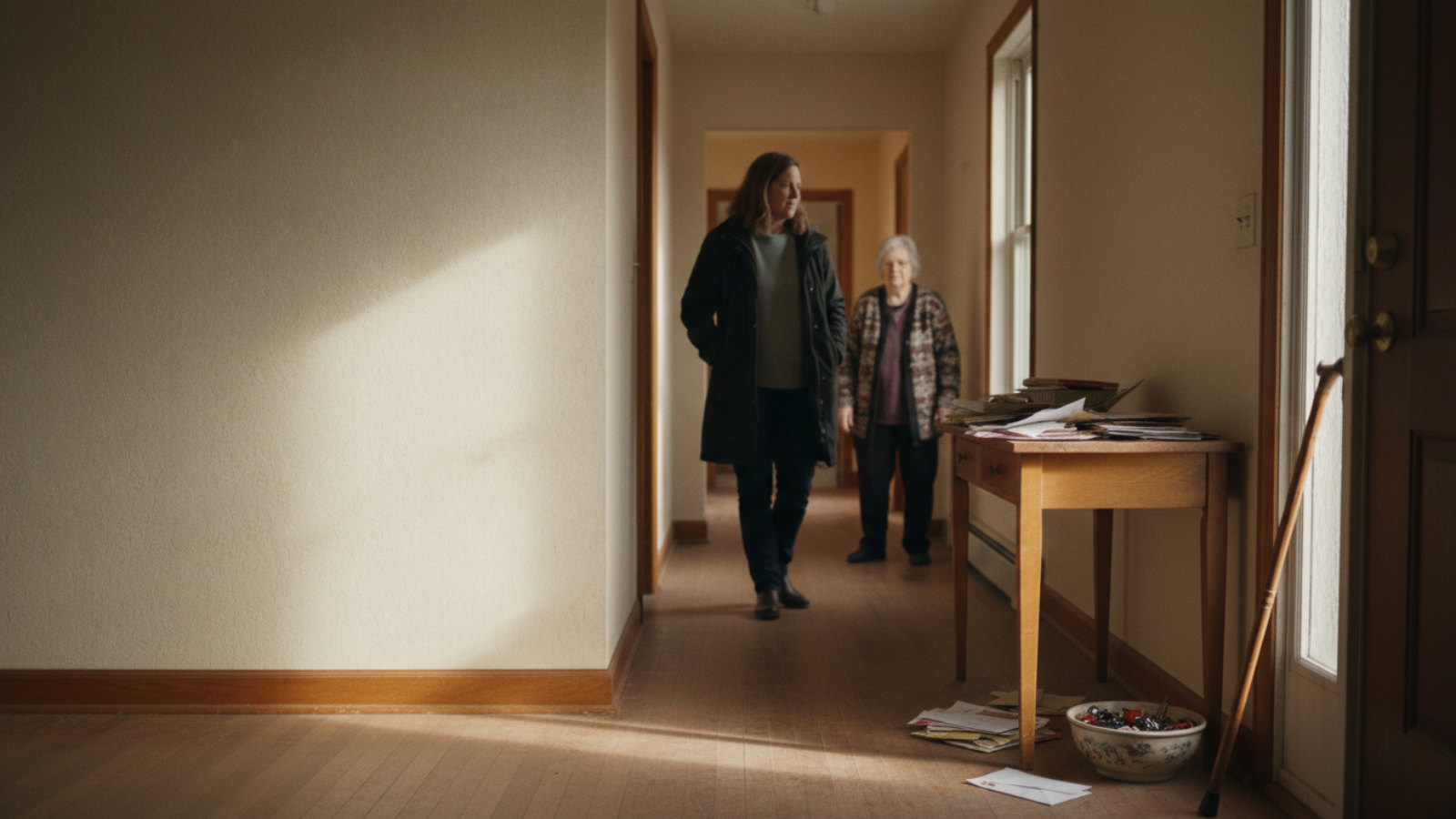
The signs an aging parent needs help are rarely dramatic. Usually there's no single moment, no fall, no phone call from a neighbor, just mail piling up on the counter, the same shirt three days running, and a pot left on the stove a little too long, small things that are easy to explain away one at a time.
Most adult children don't ask "does my parent need help" until something forces the question. By then, the pattern has often been building for months. The hard part is seeing clearly, because you're too close to it and the changes are too gradual to register day to day.
The stakes are higher than they look, because most parents want to stay where they are. According to AARP's 2024 Home and Community Preferences survey, roughly three in four adults age 50 and older want to remain in their current home as they age. Catching early signs gives a family more room to make that possible, because small problems are usually easier to address before a fall, a hospital stay, or a forced move. Seeing where your parent stands lets you work from observation instead of worry.
This article is general information for families. The InPlace Score is not a medical assessment. If you have concerns about your parent's health, consult their healthcare provider.
The signs an aging parent needs help
The signs an aging parent needs help fall into a few categories, and they're more specific than "slowing down," which comes with age. You're watching for change from your parent's own baseline, across the parts of daily life that keep someone safe and independent at home.
Changes in the home. Look for unopened mail, unpaid bills, or stacks of paperwork they used to stay on top of, a fridge with expired or spoiled food or very little food at all, burn marks on cookware, and a house that's noticeably less clean than it used to be. These point to trouble with the planning and follow-through that running a household requires.
Changes in the body. Watch for weight loss you can see in their face or clothes, and for new bruises, especially on the arms or hips, which can signal falls they haven't mentioned. Falls are common and badly underreported. The CDC reports that about one in four adults age 65 and older falls each year, and fewer than half tell their doctor. Unexplained weight loss and new falls are both worth raising with their doctor. A fall with an injury, a hit to the head, or trouble breathing calls for a same-day call to their doctor, or 911. Other signs include difficulty getting up from a chair, holding furniture or walls to move through a room, and wearing the same clothes repeatedly or showing up unwashed when that was never their pattern.
Changes in the mind. Signs include repeating questions or stories within a single conversation, missing appointments, confusion about what day or month it is, trouble following a recipe they've made for decades, and getting lost on a familiar route. Forgetting names is common with age, while forgetting how to do a routine task is a different kind of change and worth raising with their doctor. Confusion that comes on suddenly, over hours or days, needs medical attention the same day, so call their doctor that day, or 911 if it comes with slurred speech, weakness, or a drooping face.
Changes in mood and connection. Watch for pulling back from friends, church, or activities they used to count on, less interest in things that used to light them up, a flatter voice on the phone, and more irritability or anxiety than usual. Isolation can make every other change harder to manage, so a parent who's withdrawing is worth close attention. If your parent talks about not wanting to live or about harming themselves, call or text 988 to reach the Suicide and Crisis Lifeline, or call 911 if they're in immediate danger.
One of these in isolation is usually nothing. Several of them together, or one that keeps getting worse, is the pattern that says it's time to pay closer attention. If you've already had the feeling that something is off, that instinct is data too.
Why these signs are so hard to see
Families miss concrete signs for a long time because the conditions that make caregiving hard also make observation hard.
Gradual change hides itself. Decline that happens over months registers as a new normal. Each small adjustment feels minor in the moment, and your sense of "how Mom is" updates quietly to match. By the time the gap is obvious, you've already absorbed a dozen smaller shifts without noticing them.
Distance distorts both ways. If you live far away, you see your parent in snapshots, and people rally for a visit. Your dad showers, dresses well, and pulls it together for the weekend you're there, so you leave reassured. If you live close and see your parent constantly, the opposite happens. You're too embedded to spot the trend, because nothing looks different from yesterday.
Your parent is managing the impression. Many older adults know exactly what's at stake. They've heard the conversations about assisted living. So they cover. They keep the visit short, steer away from hard topics, and minimize. "I'm fine" is a complete sentence designed to end the inquiry. It's a person protecting their independence.
You don't have a baseline you can point to. You carry an impression of how your parent is doing, but it lives in your head, it's fuzzy, and it drifts. Without something written down, you can't compare March to June. You're left arguing from memory, which is exactly the kind of evidence families discount, including your own siblings. This is why "is this normal or is something wrong" is the question that keeps caregivers up at night. There's no reference point to check against.
A framework for what to watch: 15 dimensions of daily living
Clinicians break daily function into specific, observable categories and check each one. You can use the same approach at home, without any medical training.
These categories are usually grouped as activities of daily living and instrumental activities of daily living, which is the standard clinical framework for measuring whether someone can live safely on their own. Kintently's InPlace Score organizes them into 15 dimensions: bathing, dressing, mobility, eating, toileting, socialization, medications, healthcare, transportation, finances, meals, cleaning, maintenance, shopping, and communications.
The value of a framework is that it turns a vague worry into a specific check. Instead of asking "is Mom okay," you ask "how is Mom's mobility this month compared to last," and that's a question you can actually answer. You're noticing in a structured way across the areas that matter most, and leaving diagnosis to their doctor.
A few areas are worth watching closely. Changes in mobility, cognition, and mood often ripple into the rest of daily life: when mobility drops, the risk of falls and isolation rises, and when mood drops, eating and social contact often slip too. Watching those areas gives you an early read on the others.
A full pill organizer shows the prescriptions are filled. The other dimensions show whether your father is steady on his feet, eating real meals, and getting out of the house, and our piece on medication tracking goes further into the gap.
A bad day versus a real trend
One of the hardest judgments in caregiving is telling a rough day apart from a downward slope. Get it wrong in one direction and you over-react to normal variation. Get it wrong in the other and you miss a decline that needed attention weeks ago.
A bad day is a single low point with no pattern around it. Your mother is foggy on Tuesday, sharp again by Thursday, and the rest of the week looks like her usual self. A trend is the same dimension drifting in one direction across several check-ins, with the good days getting less good and showing up less often.
A common mistake is reacting to individual days. One scary phone call, and everyone's ready to move Dad into memory care. One good visit, and everyone relaxes and stops watching. Both reactions are driven by the most recent data point instead of the shape of the data over time. The difference between a bad day and a trend is only visible when you can see more than one day at once.
This is also where "steady" gets misread. In the InPlace Score, Steady is the middle band, a parent who's holding their level, and it's a band where small declines can hide. A parent can sit at Steady for months while one dimension quietly erodes underneath the stable-looking average. Watching the trend in each dimension as well as the overall number is how you catch that early.
How to track it without making it a second job
A consistent, low-effort way to note what you see is enough, so that "how's Mom" stops living in your head and starts living somewhere you and your family can actually look at.
The InPlace Score is built for this. Each of the 15 dimensions gets a score from a short check-in, and the dimensions roll up into one composite number on a 0 to 1,000 scale, sorted into five status bands: Strong (801 and above), Good (601 to 800), Steady (401 to 600), Watch (201 to 400), and Concern (200 and below). The bands give the whole family a shared vocabulary. "Dad's at Watch in mobility this month" carries more information, and less alarm, than "I think Dad's getting wobbly."
The check-in also tracks the person doing the caring. If the person doing the watching is running on empty, the quality of the care is affected no matter how the parent is doing, and in many families one adult child is carrying far more of the load than the others realize.
Tracking helps you calibrate. When you can see two months of check-ins at once, you can tell whether last week's bad day was noise or signal, and you can make the call about whether to involve a doctor from evidence instead of fear.
What to do when the signs add up
If several signs are pointing the same direction, you can work through the next steps before a crisis sets the order.
Write down what you've actually seen. Note specific observations, with rough dates. "Two falls in May; stopped gardening in April; missed two doctor's appointments." Concrete notes turn a feeling into something a doctor and your siblings can act on.
Get the rest of the family looking at the same thing. A lot of family conflict in caregiving comes from siblings working off different impressions. The brother who visits twice a year genuinely believes Dad is fine, because the Dad he sees is the performance. A shared view of the trend can settle that argument early. Start a family check-in and let everyone see the same picture.
Talk to the doctor with specifics. A standard doctor's visit doesn't catch much of this, because the appointment is short and your parent is on their best behavior. Walking in with a written record of what you've observed at home gives the doctor far more to work with.
Pace yourself. Recognizing that your parent needs help is also the moment you become a caregiver in earnest, and that role has a way of expanding to fill everything. Watch your own capacity as carefully as you watch your parent's. If you're not sure where you stand, the Kintently burnout quiz takes a few minutes.
Seeing aging clearly, early, and together shapes nearly every decision that comes next.
Frequently asked questions
What are the signs an aging parent needs help? The signs an aging parent needs help include changes in the home (piled-up mail, spoiled food, unpaid bills), changes in the body (weight loss, new bruises, difficulty getting up), changes in the mind (repeating questions, missed appointments, confusion about dates), and changes in mood (withdrawing from friends and activities, flatter affect, more irritability). One sign in isolation is usually normal. Several together, or one that keeps worsening, is the pattern that signals it's time to pay closer attention.
How do I know if my parent's decline is serious or just normal aging? Normal aging is gradual and stable. A serious decline is a change from your parent's own baseline that drifts in one direction across weeks, with good days becoming less frequent. The way to tell them apart is to track specific dimensions of daily living over time rather than reacting to any single day. A bad day with no pattern around it is usually just a bad day. The same dimension dropping across several check-ins is a trend worth acting on.
What should I track to assess an aging parent? Track the full range of areas that keep someone safe and independent at home, from medications to mobility and meals. Kintently's InPlace Score organizes this into 15 dimensions: bathing, dressing, mobility, eating, toileting, socialization, medications, healthcare, transportation, finances, meals, cleaning, maintenance, shopping, and communications. Changes in mobility, cognition, and mood often ripple into other areas, so they're worth watching closely.
How do I get my siblings to take it seriously? Siblings often disagree because they're working from different impressions. The one who visits rarely sees a parent on their best behavior, while the one nearby is too close to spot the trend. A shared, written record of what's actually happening over time replaces dueling memories with one picture everyone can see. The InPlace Score gives families a shared status everyone can look at, which can settle the disagreement early.
Suggested JSON-LD (Article schema):
{
  "@context": "https://schema.org",
  "@type": "Article",
  "headline": "How to know if your aging parent needs help: an assessment guide",
  "description": "Signs an aging parent needs help are easy to miss when you see them every day. Learn what to watch for and how to tell a bad day from a trend.",
  "author": {
    "@type": "Organization",
    "name": "Kintently"
  },
  "publisher": {
    "@type": "Organization",
    "name": "Kintently",
    "logo": {
      "@type": "ImageObject",
      "url": "https://kintently.com/logo.svg"
    }
  },
  "datePublished": "2026-06-10",
  "dateModified": "2026-06-10",
  "mainEntityOfPage": "https://kintently.com/resources/aging-parent-assessment-guide",
  "keywords": ["signs aging parent needs help", "how to know if parent is declining", "when to worry about aging parent", "aging parent assessment", "15 dimensions of daily living"]
}
{
  "@context": "https://schema.org",
  "@type": "FAQPage",
  "mainEntity": [
    {
      "@type": "Question",
      "name": "What are the signs an aging parent needs help?",
      "acceptedAnswer": {
        "@type": "Answer",
        "text": "The signs an aging parent needs help include changes in the home (piled-up mail, spoiled food, unpaid bills), changes in the body (weight loss, new bruises, difficulty getting up), changes in the mind (repeating questions, missed appointments, confusion about dates), and changes in mood (withdrawing from friends and activities, flatter affect, more irritability). One sign in isolation is usually normal. Several together, or one that keeps worsening, is the pattern that signals it's time to pay closer attention."
      }
    },
    {
      "@type": "Question",
      "name": "How do I know if my parent's decline is serious or just normal aging?",
      "acceptedAnswer": {
        "@type": "Answer",
        "text": "Normal aging is gradual and stable. A serious decline is a change from your parent's own baseline that drifts in one direction across weeks, with good days becoming less frequent. The way to tell them apart is to track specific dimensions of daily living over time rather than reacting to any single day. A bad day with no pattern around it is usually just a bad day. The same dimension dropping across several check-ins is a trend worth acting on."
      }
    },
    {
      "@type": "Question",
      "name": "What should I track to assess an aging parent?",
      "acceptedAnswer": {
        "@type": "Answer",
        "text": "Track the full range of areas that keep someone safe and independent at home, from medications to mobility and meals. Kintently's InPlace Score organizes this into 15 dimensions: bathing, dressing, mobility, eating, toileting, socialization, medications, healthcare, transportation, finances, meals, cleaning, maintenance, shopping, and communications. Changes in mobility, cognition, and mood often ripple into other areas, so they're worth watching closely."
      }
    },
    {
      "@type": "Question",
      "name": "How do I get my siblings to take it seriously?",
      "acceptedAnswer": {
        "@type": "Answer",
        "text": "Siblings often disagree because they're working from different impressions. The one who visits rarely sees a parent on their best behavior, while the one nearby is too close to spot the trend. A shared, written record of what's actually happening over time replaces dueling memories with one picture everyone can see. The InPlace Score gives families a shared status everyone can look at, which can settle the disagreement early."
      }
    }
  ]
}
This is part of Kintently's family caregiving library.